

n November, 2016, during a training run on Copper Mountain, in Colorado, just before the start of the downhill-racing season, Lindsey Vonn crashed and shattered her humerus, the biggest bone in her right arm. Surgeons pieced it back together with a metal plate and nineteen screws, but nerve damage remained. Even after she began to regain the use of her arm, Vonn couldn’t grip a toothbrush. Her rehabilitation included not only her usual gantlet of athletic torture—Vonn spent six to eight hours a day in the gym, and was reported to be doing pullups sooner than expected—but also exercises to help her hold a pencil. Every day, she practiced writing her ABCs. She returned to racing, two months after the crash, but her hand was mostly useless, and she struggled to hold onto her ski pole. After dropping her pole during the world championship, it was duct-taped to her glove before races.
At the time of the crash, Vonn was eleven wins behind Ingemar Stenmark’s record of eighty-six World Cup victories. Breaking that benchmark seemed within reach: she’d had nine wins on the World Cup circuit the previous season, and eight wins the year before. She already had a claim to being one of the greatest alpine skiers of all time, if not the greatest. But she didn’t want to leave any doubt. She returned, and fast. She was blunt about her motivation. In her second race back, she took an aggressive route along the fall line, made up time on the steepest pitch of the course, and won. Ten to go.
She kept pushing. In 2018, she won another five World Cup races, leaving her five victories from breaking Stenmark’s record. But already it was clear that her body was too broken to ski for long. She couldn’t tuck into the most aerodynamic position, couldn’t apply proper pressure to her knees, and couldn’t train without pain. In the fall of 2018, Vonn announced that she would retire after the season—and then, before the season even began, she tore her L.C.L. and suffered another three fractures in her left leg during training. At thirty-four years old, she managed to come back with enough strength, and determination, to race in the downhill at the 2019 world championship. She won bronze and then limped away from the sport.
ESPN the Magazine asked Vonn how different she would be if she’d had better health throughout her career. “I’m a much happier person because of the injuries,” she replied. “If I didn’t have those setbacks, it would be too easy. Everyone needs an obstacle to overcome to show yourself what you are capable of.” She was, by then, considered the best ever—and her success was magnified by her charisma and the glamorous, unapologetic way that she seemed to speed through life. (She dated Tiger Woods for three years—after he confessed an addiction to sex.) Still, in a statement she released upon her retirement, she admitted regrets, singling out her failure to break Stenmark’s record. “Retiring isn’t what upsets me,” she said. “Retiring without reaching my goal is what will stay with me forever.”
Winning wasn’t what drove Mikaela Shiffrin when she was a young racer. Her parents, who coached her, instilled a different kind of obsession: the elusive “perfect turn.” The family, based in Colorado at the time, left to venture east, where mountain conditions more closely resembled the scraped, icy carapaces of traditional alpine courses. Skiing fresh powder—manna to most skiers—was considered a waste of time, and teammates at her high school, a specialized ski academy in Vermont, recall her spurning the rare opportunities for free skiing in favor of fine-tuning her edge control. Actual races were considered a distraction from practice: too much waiting around.
Of course, she won races anyway—lots of them. As a technical skier, she was a prodigy. She joined the World Cup circuit as a teen-ager and bunked with her mother on the road. Shiffrin became the third-youngest American to win a World Cup race, at seventeen, and the youngest from any country to win an Olympic gold in slalom, at eighteen. She dominated the slalom—a shorter, shallower, more technical event than the downhill—and, eventually, the giant slalom as well. She could compete with anyone in the steeper speed events, too; she has four downhill World Cup victories and five in the slightly more turny Super G. But the gap between her and the field has always been greatest in the slalom, where time is gained or lost on the minutiae of technique, and not just a willingness to bomb.
She won more and more races: another Olympic gold in the slalom, World Cup races, World Cup disciplines, World Cup over-all championships—the skier’s highest reward, more valued than the Olympics. (Vonn has won four of those.) As Vonn’s injuries mounted, there was more and more talk that Shiffrin rather than Vonn might be the one to break Stenmark’s once unbreakable record. But she didn’t engage with the speculation. As ever, she was racing not so much to best her competitors as she was to chase an ideal. Even coming to terms with mistakes became something she pursued with determination. After a third-place finish in one competition, she described herself as happy to have raced with the aggressive mind-set that she wanted. “It’s nice to be fast when you have a perfect run,” she said, “but it’s better for me to also feel like you can also be fast even if you’re not totally on point but you have the right attitude, so it was a good thing.”
Was this an attempt to convince herself, a way of relieving the incredible pressure? In 2019, Shiffrin won the over-all title, and became the first skier in history to finish at the top of the standings in the slalom, giant slalom, and Super G. In twenty-nine races, she made the podium twenty-four times, and she had a record seventeen World Cup victories. She was poised to surpass Vonn as the greatest skier in history. Then her father died in an accident. The world shut down for COVID. In interviews, she talked about her self-doubts, her desire to speak out on social issues, her willingness to leave behind the perfect image she’d curated on Instagram. The pressure to ski perfectly, perhaps, was harder to shake, as was her grief. She went into the Beijing Olympics as one of the most hyped American athletes in competition, planning on entering six events. But she crashed in three of six races, and didn’t medal once—by her standards, a catastrophe. Afterward, she talked about the overwhelming expectations and described a “mind-body disconnect.”
Video From The New Yorker
Could Overtime Larry Change the Game of Teen Hoops?
She talked to reporters about measuring success independent of podium results, about mental health and persistent doubts, and about the unending process of grieving for her dad. She made herself a poster child for saying it’s O.K. to fail—sort of. The following January, she passed Vonn with her eighty-third World Cup title, and in March she won her eighty-seventh, breaking Stenmark’s record.
After retiring, Vonn walked with a limp. Her knees were a mess—particularly her right knee, which was more or less a tangle of scar tissue and cartilage. In 2024, she got a partial knee replacement, titanium implants that resurfaced the outer part, while leaving her core ligaments intact. It worked. Once she recovered, she was pain-free. And so, she decided to come back to skiing.
She returned that November. It was hard to guess what would happen: no one had tried to do what she was doing before. She was forty years old. She had been retired for five years. She had a partially replaced knee. Just being on skis in World Cup races made the comeback, in some respects, an unfathomable success. But Vonn has never been one for participation trophies. She persuaded an old friend, the Norwegian skier Aksel Lund Svindal—a two-time Olympic gold medallist and five-time world champion—to be her coach. In the off-season, she packed on muscle. Free of pain, she was finally liberated to train at length, and to toy with her equipment and refine her technique. She talked about being in as good a shape as she had ever been, of skiing fast and calmly instead of desperately. And it wasn’t just talk. In December, she won the first World Cup downhill race of the season—and then won another. She made it onto five consecutive podiums. With the Olympics approaching, she was one of the favorites.
Shiffrin, meanwhile, was pursuing her own comeback. She crashed in Killington at the end of November, 2024, in a giant-slalom race, and something, probably the tip of a gate, pierced her abdomen, nearly puncturing her colon and ripping through her core. She had to relearn how to use her stomach muscles as they reknit together—an experience she described to the Athletic as “grueling.” But she saw an upside: as she rebuilt her obliques, she learned how to engage her muscles and move her torso correctly, without compensating for weaknesses. Skiing is not the only thing that should be done with proper technique
After coming back, she returned to the slalom without missing a beat. So far this season, she’s won seven of eight World Cup slalom races. The giant slalom has been a bigger challenge—because of her crash, she had symptoms of P.T.S.D.
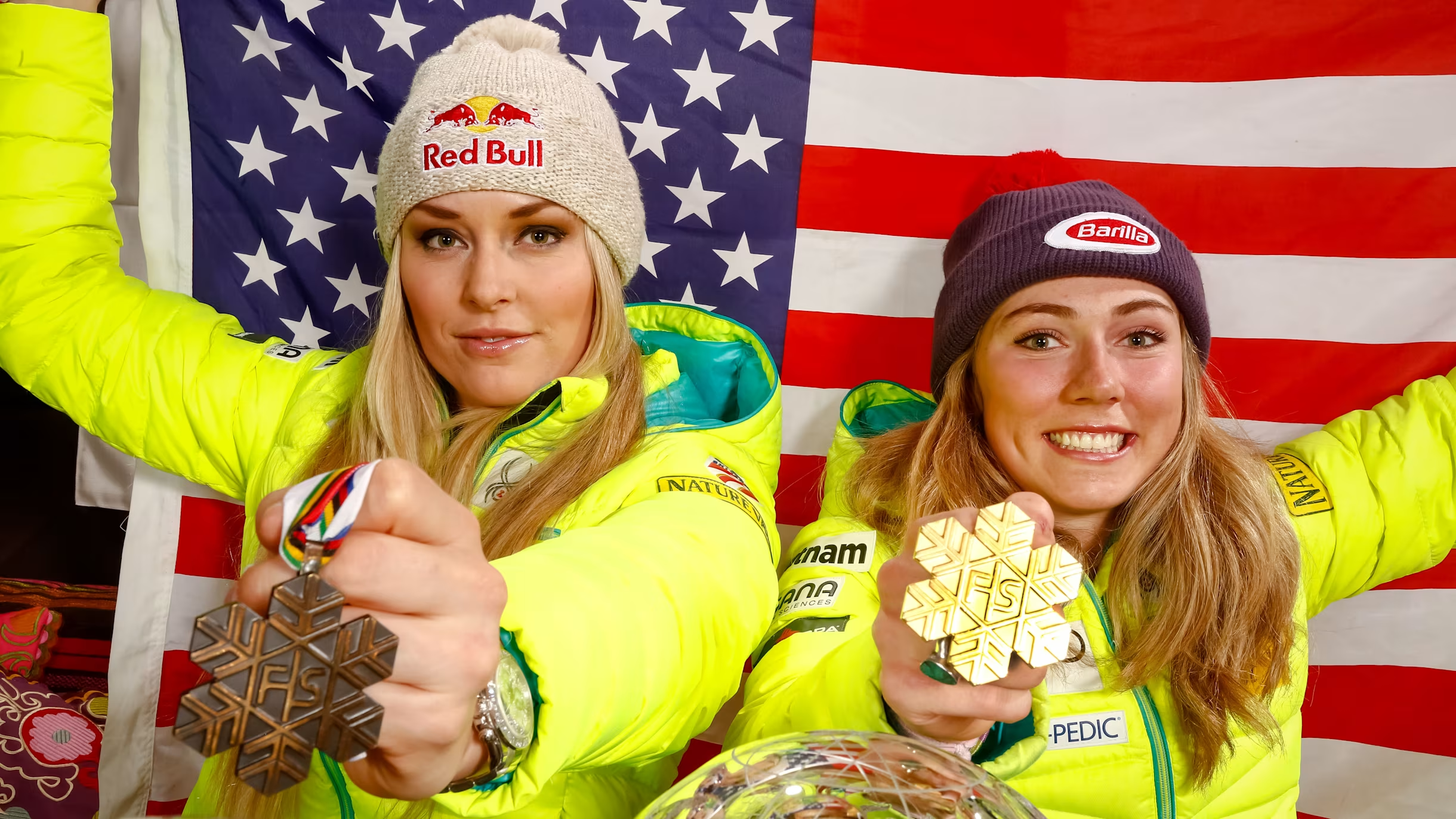
In alpine skiing, the rational emotion is fear. But the GOATs are different from you and me. They’re even different, it seems, from one another. In January, Shiffrin extended her record of World Cup wins to a hundred and eight. And in the final giant-slalom World Cup race before the Olympics, at the end of January, Shiffrin made it onto the podium, finishing third—a mere five-hundredths behind second, and 0.23 seconds behind Sarah Hector, the reigning Olympic champion, in first.
At the Olympics, Shiffrin will be skiing only slalom and giant slalom. What are her chances of victory? And how much does it matter? It would be reckless to guess. There is so much a skier—no matter how much she’s willing to risk, no matter how much she prepares—can’t control.
A week before official Olympic training runs were set to begin in the small ski town of Cortina d’Ampezzo, Italy, Vonn raced in treacherous, low-visibility conditions at a World Cup event in Switzerland, crashed, and hurt her left knee. She was airlifted out, dangling from a net. Afterward, she announced that she’d ruptured her A.C.L.—and that, if she was at all physically able, she planned to ski in the Olympics anyway. Immortality was still on the table.
After two successful training runs, Vonn seemed poised to do what only she could have dreamed. On Sunday morning, in Cortina, she erupted out of the gate, the thirteenth skier to race. Her teammate, Breezy Johnson, was in first. But after just thirteen seconds, Vonn clipped a gate and lost her balance. She tumbled down the mountain, skidding to a stop with her skis splayed. The crowd fell into a stunned silence, which made it possible to hear her cries of pain.
Vonn was helicoptered off the mountain. Johnson hung on to win the gold medal. For Vonn, perhaps it could only ever end this way.
But nothing is inevitable in alpine skiing except the brute force of gravity. Vonn’s great gift had always been to make that force her own, using the downward pull in combination with her strength and mass to plummet down sheets of ice at speeds higher than seventy miles per hour. She didn’t fight the natural sensation of falling, which was key to keeping herself upright. Still, sometimes, she fell. At the Turin Olympics, in 2006, she bruised her hip and back so badly in a crash during a training session that she was helicoptered off the mountain. Two days later, she went straight from her hospital bed back to the slopes. The next season, she tore her A.C.L. She won gold at the 2010 Vancouver Olympics with a shin so severely bruised that she could barely walk. She tried, and failed, to race with a concussion; after tearing her A.C.L. again, in 2014, she couldn’t race at all. She broke her ankle in the summer of 2015, and sustained three fractures in her knee in February, 2016. Then came the broken arm.


